Wi-Fi RFFI Signal-Level Synthetic Traces
This resource provides synthetic Wi-Fi signal traces generated at the bit level with hardware impairments, designed for RFFI-based impersonation detection research.
Overview
The dataset supports the study of radio frequency fingerprinting identification (RFFI) for detecting device impersonation in Wi-Fi networks. Signals are generated at the bit level using 16-QAM and OFDM modulation, with device-specific hardware impairments including CFO, IQ imbalance, phase noise, and non-linear distortions. Transmission effects are simulated using additive white Gaussian noise and Rayleigh fading channels.
What is included
- IQ traces for 4 legitimate devices under
data/legitimate/ - IQ traces for 4 attacker devices under
data/attacker/, each impersonating a corresponding legitimate device - hardware impairments: CFO, IQ imbalance, phase noise, non-linear distortion
- channel effects: AWGN and Rayleigh fading
scripts/analyze.pyfor feature extraction and XGBoost-based device classification
Dataset context
The dataset was generated to evaluate unsupervised anomaly detection for Wi-Fi impersonation attacks. Each legitimate device has unique hardware fingerprint parameters assigned via a separable parameter grid. Attacker devices share the MAC address of their target legitimate device while retaining distinct hardware characteristics, simulating realistic impersonation scenarios.
Each .npy file contains 1000 signal samples per device with shape (1000, signal_length).
Why it matters
This dataset offers a reproducible setting for evaluating RFFI-based anomaly detection under controlled hardware impairments and channel conditions.
Access
- Dataset and code: GitHub
- License:
CC BY 4.0
Example result
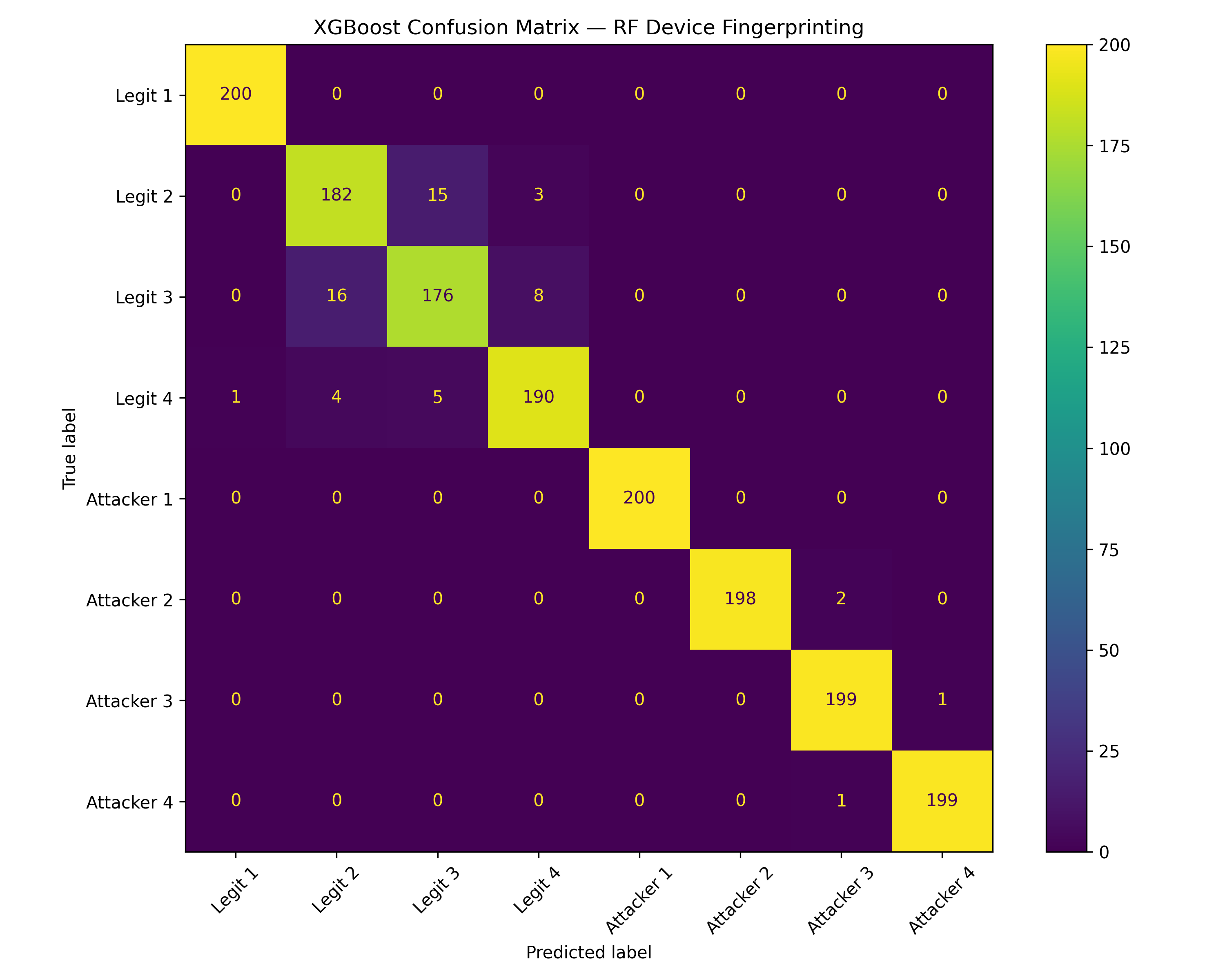
This preview shows the XGBoost classification confusion matrix on the synthetic dataset, illustrating the separability of device-specific RF fingerprints across legitimate and attacker devices.
Citation
If you use this resource, please cite the related publication above.